SEPA credit transfer file
Supplier payments from your ERP, as a pain.001 XML file
- Template
- XML
- Export as
- XML
- Carbone
- 5.18+
Generate SEPA XML files from your ERP
Accounts payable teams pay their suppliers in payment runs: the ERP proposes the invoices that fall due, a treasurer approves the run, and the ERP writes a SEPA credit transfer file to upload to the bank through EBICS, a host-to-host link or online banking. ERP treasury modules, AP automation platforms and treasury management systems produce these files every week, often every day. The file is the pain.001 message of ISO 20022, in XML: Regulation (EU) No 260/2012 requires the ISO 20022 XML format when a company other than a microenterprise sends its credit transfers bundled in a file, and the EPC SEPA Credit Transfer rulebook obliges a bank that accepts payment files to accept this format when its customer asks.
Your ERP sends the approved payments to the Carbone API as JSON and gets back a pain.001.001.09 file that follows the EPC Customer-to-PSP implementation guidelines in force since 5 October 2025. In this example, Northwind Antriebstechnik GmbH, a fictional drive systems manufacturer in Mannheim, pays 7 suppliers in 7 SEPA countries, in two blocks: 4 payments on 17 November 2026 and 3 on 20 November. The suppliers and their IBANs are fictional: each IBAN has valid check digits, on a bank code that no bank uses.
In this example, you will:
- Count the transactions and add up the control sums of the file and of each block with aggregators
- Repeat the payment blocks and their transactions with nested loops
- Print the dates and the amounts in the formats of the schema
- Convert the names and the addresses to the SEPA character set with an alias
- Add the BIC and the structured creditor reference only when the data has them
pain.001 file structure
| Block | Repeated | Main elements |
|---|---|---|
GrpHdr group header |
Once | MsgId file reference, CreDtTm creation date and time, NbOfTxs number of transactions, CtrlSum total amount, InitgPty the company that sends the file |
PmtInf payment information |
Once per execution date and debit account | PmtInfId, PmtMtd TRF, BtchBookg, NbOfTxs and CtrlSum of the block, service level SEPA, ReqdExctnDt execution date, the debtor Dbtr, its IBAN DbtrAcct, the BIC of its bank DbtrAgt, charges SLEV |
CdtTrfTxInf credit transfer transaction |
Once per payment | EndToEndId payment reference, InstdAmt amount in euros, the supplier Cdtr and its address, its IBAN CdtrAcct, the BIC of its bank CdtrAgt when needed, the remittance information RmtInf |
Banks check NbOfTxs and CtrlSum against the transactions, in the group header and in each block, and can reject a file that does not match.
SEPA credit transfer example
Template
<?xml version="1.0" encoding="UTF-8"?>
<Document xmlns="urn:iso:std:iso:20022:tech:xsd:pain.001.001.09">{o.lang=en-us}{o.timezone=Europe/Berlin}{#sepa($text, $max) = $text:unaccent:replace('ß', 'ss'):substr(0, $max)}
<CstmrCdtTrfInitn>
<GrpHdr>
<MsgId>{d.messageId}</MsgId>
<CreDtTm>{d.createdAt:formatD('YYYY-MM-DDTHH:mm:ssZ')}</CreDtTm>
<NbOfTxs>{d.batches[].payments[].amount:aggCount}</NbOfTxs>
<CtrlSum>{d.batches[].payments[].amount:aggSum:formatN(2):replace(',', '')}</CtrlSum>
<InitgPty>
<Nm>{$sepa(d.debtor.name, 70):replace('&', '+')}</Nm>
</InitgPty>
</GrpHdr>{d.batches[i]}
<PmtInf>
<PmtInfId>{d.batches[i].id}</PmtInfId>
<PmtMtd>TRF</PmtMtd>
<BtchBookg>{d.batches[i].batchBooking}</BtchBookg>
<NbOfTxs>{d.batches[i].payments[].amount:aggCount}</NbOfTxs>
<CtrlSum>{d.batches[i].payments[].amount:aggSum:formatN(2):replace(',', '')}</CtrlSum>
<PmtTpInf>
<SvcLvl>
<Cd>SEPA</Cd>
</SvcLvl>
<CtgyPurp>
<Cd>SUPP</Cd>
</CtgyPurp>
</PmtTpInf>
<ReqdExctnDt>
<Dt>{d.batches[i].executionDate:formatD('YYYY-MM-DD')}</Dt>
</ReqdExctnDt>
<Dbtr>
<Nm>{$sepa(d.debtor.name, 70):replace('&', '+')}</Nm>
<PstlAdr>
<StrtNm>{$sepa(d.debtor.street, 70)}</StrtNm>
<BldgNb>{d.debtor.buildingNumber}</BldgNb>
<PstCd>{d.debtor.postCode}</PstCd>
<TwnNm>{$sepa(d.debtor.town, 35)}</TwnNm>
<Ctry>{d.debtor.country}</Ctry>
</PstlAdr>
</Dbtr>
<DbtrAcct>
<Id>
<IBAN>{d.debtor.iban}</IBAN>
</Id>
</DbtrAcct>
<DbtrAgt>
<FinInstnId>
<BICFI>{d.debtor.bic}</BICFI>
</FinInstnId>
</DbtrAgt>
<ChrgBr>SLEV</ChrgBr>{d.batches[i].payments[i]}
<CdtTrfTxInf>
<PmtId>
<EndToEndId>{d.batches[i].payments[i].endToEndId}</EndToEndId>
</PmtId>
<Amt>
<InstdAmt Ccy="EUR">{d.batches[i].payments[i].amount:formatN(2):replace(',', '')}</InstdAmt>
</Amt>{d.batches[i].payments[i].supplier.bic:ifNEM:showBegin}
<CdtrAgt>
<FinInstnId>
<BICFI>{d.batches[i].payments[i].supplier.bic}</BICFI>
</FinInstnId>
</CdtrAgt>{d.batches[i].payments[i].supplier.bic:showEnd}
<Cdtr>
<Nm>{$sepa(d.batches[i].payments[i].supplier.name, 70):replace('&', '+')}</Nm>
<PstlAdr>
<StrtNm>{$sepa(d.batches[i].payments[i].supplier.street, 70)}</StrtNm>
<BldgNb>{d.batches[i].payments[i].supplier.buildingNumber}</BldgNb>
<PstCd>{d.batches[i].payments[i].supplier.postCode}</PstCd>
<TwnNm>{$sepa(d.batches[i].payments[i].supplier.town, 35)}</TwnNm>
<Ctry>{d.batches[i].payments[i].supplier.country}</Ctry>
</PstlAdr>
</Cdtr>
<CdtrAcct>
<Id>
<IBAN>{d.batches[i].payments[i].supplier.iban}</IBAN>
</Id>
</CdtrAcct>
<RmtInf>{d.batches[i].payments[i].creditorReference:ifNEM:showBegin}
<Strd>
<CdtrRefInf>
<Tp>
<CdOrPrtry>
<Cd>SCOR</Cd>
</CdOrPrtry>
<Issr>ISO</Issr>
</Tp>
<Ref>{d.batches[i].payments[i].creditorReference}</Ref>
</CdtrRefInf>
</Strd>{d.batches[i].payments[i].creditorReference:showEnd}{d.batches[i].payments[i].creditorReference:ifEM:showBegin}
<Ustrd>Inv. {d.batches[i].payments[i].invoices[].number:aggStr(', ')}, cust. no. {d.batches[i].payments[i].customerNumber}</Ustrd>{d.batches[i].payments[i].creditorReference:showEnd}
</RmtInf>
</CdtTrfTxInf>{d.batches[i].payments[i+1]}
</PmtInf>{d.batches[i+1]}
</CstmrCdtTrfInitn>
</Document>JSON data
{
  "messageId": "NWD-SCT-20261116-01",
  "createdAt": "2026-11-16T09:42:15Z",
  "debtor": { "name": "Northwind Antriebstechnik GmbH", "street": "Industriestraße", "buildingNumber": "18", "postCode": "68169", "town": "Mannheim", "country": "DE", "iban": "DE26670314770205417800", "bic": "WDGBDE6MXXX" },
  "batches": [
    {
      "id": "NWD-SCT-20261116-01-P1",
      "executionDate": "2026-11-17",
      "batchBooking": true,
      "payments": [
        {
          "endToEndId": "PAY-2026-04811", "amount": 24555.50, "customerNumber": "40417",
          "supplier": { "name": "Fabrikam Präzisionsteile GmbH", "street": "Marburger Straße", "buildingNumber": "112", "postCode": "35396", "town": "Gießen", "country": "DE", "iban": "DE64513204174720118365" },
          "invoices": [ { "number": "26-11873", "amount": 18420.00 }, { "number": "26-11902", "amount": 6135.50 } ]
        },
        {
          "endToEndId": "PAY-2026-04812", "amount": 9876.40, "customerNumber": "K-20931",
          "supplier": { "name": "Litware Kunststofftechnik GmbH", "street": "Wiener Straße", "buildingNumber": "131", "postCode": "4020", "town": "Linz", "country": "AT", "iban": "AT801584000428196703" },
          "invoices": [ { "number": "LW-2026-0388", "amount": 9876.40 } ]
        },
        {
          "endToEndId": "PAY-2026-04813", "amount": 3214.75, "customerNumber": "77120", "creditorReference": "RF24PV26004417",
          "supplier": { "name": "Proseware Verpakkingen B.V.", "street": "Havensingel", "buildingNumber": "52", "postCode": "5211 TX", "town": "'s-Hertogenbosch", "country": "NL", "iban": "NL42VKBN4417260133" },
          "invoices": [ { "number": "PV26004417", "amount": 3214.75 } ]
        },
        {
          "endToEndId": "PAY-2026-04814", "amount": 12480.00, "customerNumber": "NW-1180",
          "supplier": { "name": "Trey Research AG", "street": "Zürcherstrasse", "buildingNumber": "65", "postCode": "8400", "town": "Winterthur", "country": "CH", "iban": "CH0208411000427613902", "bic": "WGVECHZZXXX" },
          "invoices": [ { "number": "TR-26-5521", "amount": 12480.00 } ]
        }
      ]
    },
    {
      "id": "NWD-SCT-20261116-01-P2",
      "executionDate": "2026-11-20",
      "batchBooking": true,
      "payments": [
        {
          "endToEndId": "PAY-2026-04815", "amount": 4682.30, "customerNumber": "C0582",
          "supplier": { "name": "Wingtip Transports & Logistique SA", "street": "Rue de l'Académie", "buildingNumber": "42", "postCode": "4000", "town": "Liège", "country": "BE", "iban": "BE36716045821381" },
          "invoices": [ { "number": "F2026-10457", "amount": 4682.30 } ]
        },
        {
          "endToEndId": "PAY-2026-04816", "amount": 7950.00, "customerNumber": "30566", "creditorReference": "RF951183023",
          "supplier": { "name": "Adatum Sensors Oy", "street": "Hatanpään valtatie", "buildingNumber": "24", "postCode": "33100", "town": "Tampere", "country": "FI", "iban": "FI6677603904182572" },
          "invoices": [ { "number": "118302", "amount": 7950.00 } ]
        },
        {
          "endToEndId": "PAY-2026-04817", "amount": 15307.85, "customerNumber": "430219",
          "supplier": { "name": "Fundiciones Coho España S.L.", "street": "Calle Ribera de Deusto", "buildingNumber": "27", "postCode": "48014", "town": "Bilbao", "country": "ES", "iban": "ES4606184810382730418865" },
          "invoices": [ { "number": "FC-2026/0912", "amount": 15307.85 } ]
        }
      ]
    }
  ]
}
Generated pain.001 file
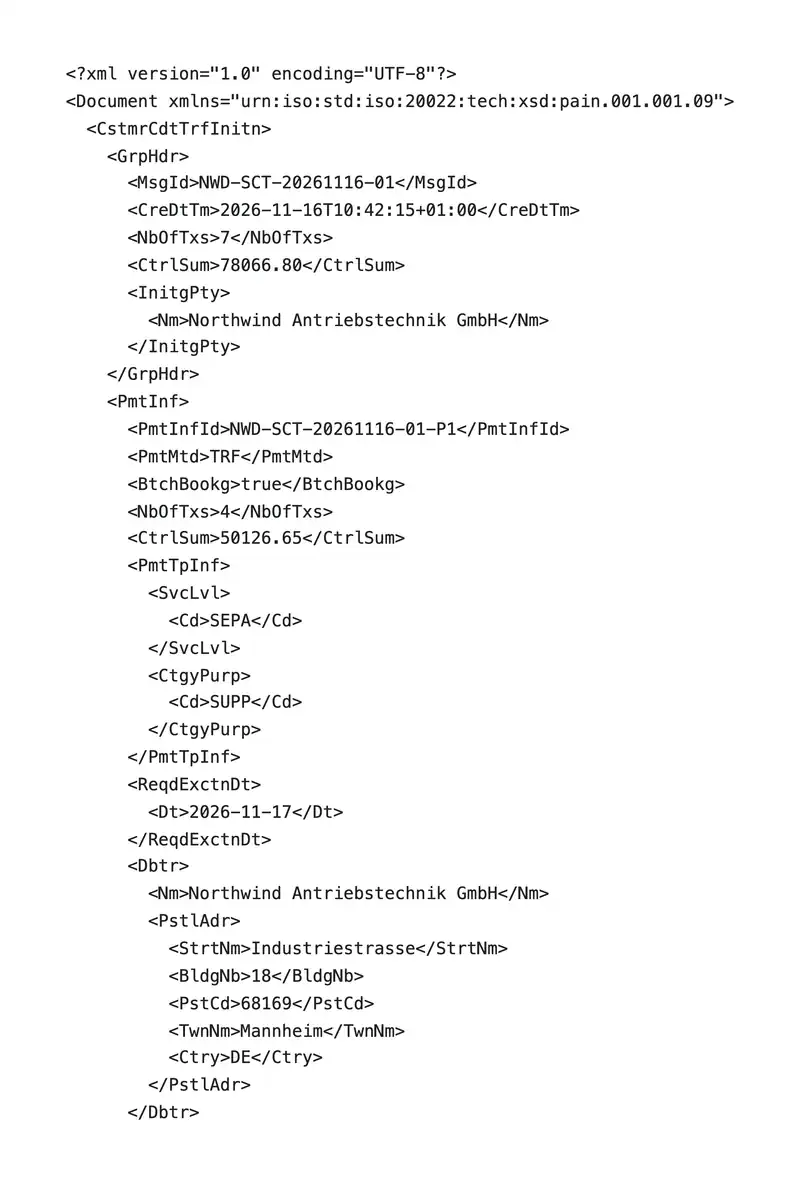
An excerpt: the group header, the start of the first block, and its third and fourth transactions.
<?xml version="1.0" encoding="UTF-8"?>
<Document xmlns="urn:iso:std:iso:20022:tech:xsd:pain.001.001.09">
  <CstmrCdtTrfInitn>
    <GrpHdr>
      <MsgId>NWD-SCT-20261116-01</MsgId>
      <CreDtTm>2026-11-16T10:42:15+01:00</CreDtTm>
      <NbOfTxs>7</NbOfTxs>
      <CtrlSum>78066.80</CtrlSum>
      <InitgPty>
        <Nm>Northwind Antriebstechnik GmbH</Nm>
      </InitgPty>
    </GrpHdr>
    <PmtInf>
      <PmtInfId>NWD-SCT-20261116-01-P1</PmtInfId>
      <PmtMtd>TRF</PmtMtd>
      <BtchBookg>true</BtchBookg>
      <NbOfTxs>4</NbOfTxs>
      <CtrlSum>50126.65</CtrlSum>
      ...
      <CdtTrfTxInf>
        <PmtId>
          <EndToEndId>PAY-2026-04813</EndToEndId>
        </PmtId>
        <Amt>
          <InstdAmt Ccy="EUR">3214.75</InstdAmt>
        </Amt>
        <Cdtr>
          <Nm>Proseware Verpakkingen B.V.</Nm>
          <PstlAdr>
            <StrtNm>Havensingel</StrtNm>
            <BldgNb>52</BldgNb>
            <PstCd>5211 TX</PstCd>
            <TwnNm>'s-Hertogenbosch</TwnNm>
            <Ctry>NL</Ctry>
          </PstlAdr>
        </Cdtr>
        <CdtrAcct>
          <Id>
            <IBAN>NL42VKBN4417260133</IBAN>
          </Id>
        </CdtrAcct>
        <RmtInf>
          <Strd>
            <CdtrRefInf>
              <Tp>
                <CdOrPrtry>
                  <Cd>SCOR</Cd>
                </CdOrPrtry>
                <Issr>ISO</Issr>
              </Tp>
              <Ref>RF24PV26004417</Ref>
            </CdtrRefInf>
          </Strd>
        </RmtInf>
      </CdtTrfTxInf>
      <CdtTrfTxInf>
        <PmtId>
          <EndToEndId>PAY-2026-04814</EndToEndId>
        </PmtId>
        <Amt>
          <InstdAmt Ccy="EUR">12480.00</InstdAmt>
        </Amt>
        <CdtrAgt>
          <FinInstnId>
            <BICFI>WGVECHZZXXX</BICFI>
          </FinInstnId>
        </CdtrAgt>
        <Cdtr>
          <Nm>Trey Research AG</Nm>
          <PstlAdr>
            <StrtNm>Zurcherstrasse</StrtNm>
            <BldgNb>65</BldgNb>
            <PstCd>8400</PstCd>
            <TwnNm>Winterthur</TwnNm>
            <Ctry>CH</Ctry>
          </PstlAdr>
        </Cdtr>
        <CdtrAcct>
          <Id>
            <IBAN>CH0208411000427613902</IBAN>
          </Id>
        </CdtrAcct>
        <RmtInf>
          <Ustrd>Inv. TR-26-5521, cust. no. NW-1180</Ustrd>
        </RmtInf>
      </CdtTrfTxInf>
      ...
How to create a SEPA XML file
1. Fill the group header
{d.messageId}prints the file reference. It must be unique for your bank, so a file sent twice can be detected.{d.createdAt:formatD('YYYY-MM-DDTHH:mm:ssZ')}prints the creation time as an ISO 8601 date and time.{o.timezone=Europe/Berlin}on the second line turns2026-11-16T09:42:15Zinto2026-11-16T10:42:15+01:00. See the date formatters.{d.batches[].payments[].amount:aggCount}counts the transactions of the whole file:7.{d.batches[].payments[].amount:aggSum:formatN(2):replace(',', '')}adds up their amounts:78066.80.{o.lang=en-us}makes:formatN(2)write two decimals after a dot, and:replace(',', '')removes the thousands separators. See the XML numbers and dates.
2. Repeat the blocks and the transactions
A PmtInf block has one execution date and one debit account, so the ERP groups the payments by date: d.batches holds the blocks, and payments the transactions of each block.
{d.batches[i]}at the end of the</GrpHdr>line and{d.batches[i+1]}at the end of the</PmtInf>line repeat the block.{d.batches[i].payments[i]}after<ChrgBr>SLEV</ChrgBr>and{d.batches[i].payments[i+1]}after</CdtTrfTxInf>repeat the transaction inside it, as a nested loop.- A loop repeats the text between its
[i]and[i+1]tags, so the file keeps its indentation, without empty lines.
Inside the block, the aggregators count its own transactions: {d.batches[i].payments[].amount:aggCount} prints 4, then 3, and {d.batches[i].payments[].amount:aggSum:formatN(2):replace(',', '')} prints 50126.65, then 27940.15. Together they make 78,066.80, the CtrlSum of the header. Learn more about aggregators.
{d.batches[i].executionDate:formatD('YYYY-MM-DD')} prints 2026-11-17, and BtchBookg true asks the bank for one debit per block on the account statement. The codes SEPA, SUPP (supplier payment) and SLEV (each party pays the charges of its own bank) are typed in the template.
3. Convert the text to the SEPA character set
SEPA banks must support the Latin character set: a to z, A to Z, 0 to 9, the space and / - ? : ( ) . , ' +. The alias on the second line removes the accents, writes ss for ß, and cuts the text at its maximum length:
{#sepa($text, $max) = $text:unaccent:replace('ß', 'ss'):substr(0, $max)}{$sepa(d.batches[i].payments[i].supplier.town, 35)}printsLiegefor Liège andGiessenfor Gießen. Names and streets are cut at 70 characters, towns at 35.- The names also get
:replace('&', '+'):Wingtip Transports & Logistique SAbecomesWingtip Transports + Logistique SA, the replacement recommended by the EPC in EPC217-08. In an XML template,&is written&. - The addresses are structured, with the town
TwnNmand the countryCtry: from 22 November 2026, the EPC guidelines allow only structured and hybrid addresses.
Learn more about parametrized aliases.
4. Add the BIC only when the bank needs it
Within the EEA, the IBAN is enough. For a supplier whose bank is in a non-EEA SEPA country, such as Switzerland, your bank can ask for the BIC when it cannot find it from the IBAN. The conditional block from {d.batches[i].payments[i].supplier.bic:ifNEM:showBegin} to :showEnd writes CdtrAgt only for the suppliers that have a BIC in the data: here, WGVECHZZXXX for Trey Research AG in Winterthur.
5. Choose the remittance information
The supplier matches the payment to its invoices with the remittance information: either Strd or Ustrd, up to 140 characters.
- When the invoice carries an RF creditor reference (ISO 11649), the block from
{d.batches[i].payments[i].creditorReference:ifNEM:showBegin}to:showEndkeepsStrd, with the codeSCOR, the issuerISOand the referenceRF24PV26004417for Proseware Verpakkingen. - Otherwise, the block from
{d.batches[i].payments[i].creditorReference:ifEM:showBegin}to:showEndkeepsUstrd.{d.batches[i].payments[i].invoices[].number:aggStr(', ')}lists the invoices of the payment:Inv. 26-11873, 26-11902, cust. no. 40417pays two Fabrikam invoices in one transfer. See :aggStr.
6. Check the file before it goes to the bank
Before going live, validate a few files with the XSD of pain.001.001.09, published by ISO 20022, and with the rules of your bank. The file of this example validates against the official schema, and against the SEPA schema of the German banking industry, GBIC_5, published on ebics.de.
Since 9 October 2025, banks in the euro area check the payee name against the IBAN before they execute a transfer (Verification of Payee). They also check the transfers of a file, unless your company opts out: send the name of the account holder in Cdtr/Nm.
Related Examples
Trusted by 800+ paid customers in 40+ countries