GHS safety data sheet
Hazard data from your SDS software, as a 16-section PDF
- Template
- DOCX
- Export as
- PDF, DOCX, ODT, HTML, PNG +25 more
- Carbone
- 4.6+
Generate safety data sheets from your software
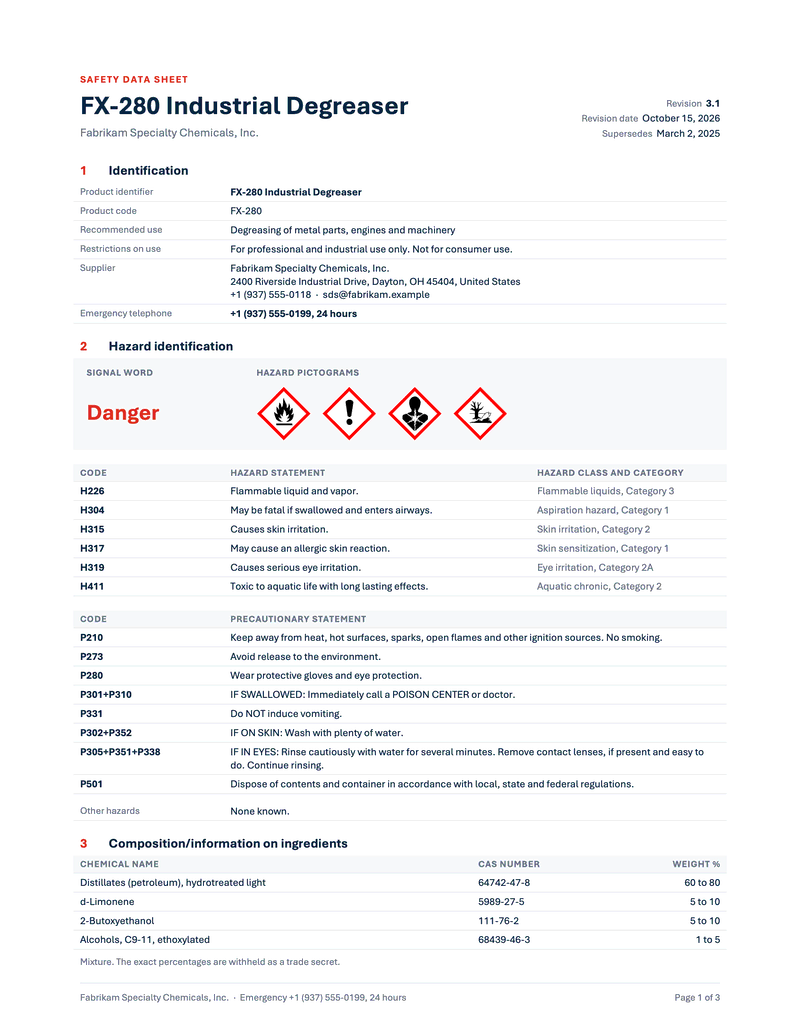
Chemical manufacturers and importers must write a safety data sheet for each hazardous chemical they produce or import, and distributors pass it on with the first shipment: in the US under OSHA 29 CFR 1910.1200(g), in the EU under REACH Article 31 and Annex II, in the language of each country where the product is sold. SDS authoring software, PLM and ERP systems hold the product data: they send it to the Carbone API as JSON and get back the PDF. In this example, Fabrikam Specialty Chemicals publishes the 3-page SDS of FX-280, a fictional industrial degreaser with a fictional classification.
The 16 sections of an SDS
The sections follow the order and the short titles of the GHS and of OSHA Appendix D. Every page repeats the product name, the revision and its date, and "Page X of Y".
| Section | Content | What Carbone does |
|---|---|---|
| 1 Identification | Product identifier, recommended use, supplier, emergency telephone | Prints the product and supplier fields |
| 2 Hazard identification | Signal word, pictograms, hazard (H) and precautionary (P) statements | Keeps the signal word and the pictograms listed in the data, one row per statement |
| 3 Composition | Chemical name, CAS number, concentration range | One row per ingredient |
| 4 First-aid measures | Measures by route of exposure, symptoms | One row per item |
| 5 Fire-fighting measures | Extinguishing media, specific hazards | One row per item |
| 6 Accidental release measures | Precautions, containment and cleanup | One row per item |
| 7 Handling and storage | Safe handling, storage conditions | One row per item |
| 8 Exposure controls | Exposure limits, protective equipment | One row per item |
| 9 Physical and chemical properties | The 18 properties of OSHA Appendix D, from physical state to particle characteristics | One row per property |
| 10 Stability and reactivity | Conditions to avoid, incompatible materials | One row per item |
| 11 Toxicological information | Routes of exposure, acute toxicity, carcinogenicity | One row per item |
| 12 Ecological information | Ecotoxicity, persistence, mobility | One row per item |
| 13 Disposal considerations | Waste disposal, EPA waste code | One row per item |
| 14 Transport information | UN number, shipping name, class, packing group | The table for a regulated product, a sentence otherwise |
| 15 Regulatory information | TSCA, SARA 311/312 | One row per item |
| 16 Other information | Revision date, changes | Formats the dates |
OSHA does not enforce sections 12 to 15, but the GHS and REACH require them, so the template keeps all 16.
Safety data sheet example
Template
The DOCX template is a Word document with Carbone tags. The key tags:
| Where | Tag |
|---|---|
| Section title | {t(Hazard identification)} |
| Signal word | Danger{d.hazards.signalWord:ifNE(Danger):drop(p)} |
| Alt text of the GHS02 pictogram | {d.hazards.pictograms:ifNIN(GHS02):drop(img)} |
| H statement row | {d.hazards.statements[i].code} {d.hazards.statements[i].text} {d.hazards.statements[i].class} |
| Ingredient row | {d.composition.substances[i].cas} {d.composition.substances[i].min} to {d.composition.substances[i].max} |
| Property row | {d.properties[i].label} {d.properties[i].value} |
| Section 14 table | {d.transport.regulated:ifEQ(false):drop(table)} |
| Header | Revision {d.sds.revision} · {d.sds.revisionDate:formatD(LL)} |
JSON data
An excerpt; the data sample has every field of the 16 sections.
{
  "sds": { "revision": "3.1", "revisionDate": "2026-10-15", "supersedes": "2025-03-02" },
  "product": { "name": "FX-280 Industrial Degreaser", "code": "FX-280" },
  "hazards": {
    "signalWord": "Danger",
    "pictograms": ["GHS02", "GHS07", "GHS08", "GHS09"],
    "statements": [
      { "code": "H226", "text": "Flammable liquid and vapor.", "class": "Flammable liquids, Category 3" },
      { "code": "H304", "text": "May be fatal if swallowed and enters airways.", "class": "Aspiration hazard, Category 1" }
    ],
    "precautions": [
      { "code": "P301+P310", "text": "IF SWALLOWED: Immediately call a POISON CENTER or doctor." }
    ]
  },
  "composition": {
    "substances": [
      { "name": "Distillates (petroleum), hydrotreated light", "cas": "64742-47-8", "min": 60, "max": 80 },
      { "name": "2-Butoxyethanol", "cas": "111-76-2", "min": 5, "max": 10 }
    ]
  },
  "firstAid": [
    { "label": "Ingestion", "text": "Do NOT induce vomiting. Call a poison center or doctor immediately." }
  ],
  "properties": [
    { "label": "Flash point", "value": "47 °C (117 °F), closed cup" }
  ],
  "transport": { "regulated": true, "unNumber": "UN1993", "hazardClass": "3", "packingGroup": "III" }
}
How to create a safety data sheet
1. Number the sections and translate their titles
Each section starts with a heading: the number in red, then a translation tag such as {t(Hazard identification)}. Without a dictionary, Carbone prints the key, so the English SDS needs no translation file. For the German SDS, send "lang": "de-de" with this dictionary in the render request: section 2 becomes "Mögliche Gefahren", and :formatD(LL) prints the revision date as "15. Oktober 2026".
"translations": {
  "de-de": {
    "Safety data sheet": "Sicherheitsdatenblatt",
    "Identification": "Bezeichnung des Stoffs bzw. des Gemischs und des Unternehmens",
    "Hazard identification": "Mögliche Gefahren",
    "Composition/information on ingredients": "Zusammensetzung/Angaben zu Bestandteilen",
    "First-aid measures": "Erste-Hilfe-Maßnahmen",
    "Fire-fighting measures": "Maßnahmen zur Brandbekämpfung",
    "Accidental release measures": "Maßnahmen bei unbeabsichtigter Freisetzung",
    "Handling and storage": "Handhabung und Lagerung",
    "Exposure controls/personal protection": "Begrenzung und Überwachung der Exposition/Persönliche Schutzausrüstungen",
    "Physical and chemical properties": "Physikalische und chemische Eigenschaften",
    "Stability and reactivity": "Stabilität und Reaktivität",
    "Toxicological information": "Toxikologische Angaben",
    "Ecological information": "Umweltbezogene Angaben",
    "Disposal considerations": "Hinweise zur Entsorgung",
    "Transport information": "Angaben zum Transport",
    "Regulatory information": "Rechtsvorschriften",
    "Other information": "Sonstige Angaben"
  }
}
The labels and phrases of each section come from your data, in the language of the SDS. The heading style has outline level 1, so the PDF gets one bookmark per section.
2. Show the signal word and the pictograms of the product
- The signal word is two paragraphs:
Danger{d.hazards.signalWord:ifNE(Danger):drop(p)}in red andWarning{d.hazards.signalWord:ifNE(Warning):drop(p)}in amber. The smart condition drops the paragraph that does not match: FX-280 prints Danger. - The template holds the nine official GHS pictograms on one line, and the alt text of each one has a drop tag:
{d.hazards.pictograms:ifNIN(GHS05):drop(img)}removes the corrosion pictogram because GHS05 is not ind.hazards.pictograms. FX-280 keeps the flame, the exclamation mark, the health hazard and the environment.
3. Repeat the statements, the ingredients and the properties
- Each table repeats a row with a loop:
{d.hazards.statements[i].code}in the first row,{d.hazards.statements[i+1].code}in the second. Carbone prints six H statements and eight P statements. {d.composition.substances[i].min} to {d.composition.substances[i].max}prints60 to 80, one of the ranges that OSHA prescribes when the exact percentage is a trade secret.- Sections 4 to 13 and 15 are two-column tables with one loop each, like
{d.firstAid[i].label}and{d.firstAid[i].text}. Section 9 lists the 18 properties the same way.
4. Show section 14 only for a regulated product
The transport table has {d.transport.regulated:ifEQ(false):drop(table)} in its first cell, and the sentence under it ends with {d.transport.regulated:ifEQ(true):drop(p)}. With "regulated": true, FX-280 shows UN1993, class 3 and packing group III. With false, the heading stays and the SDS says "Not regulated as dangerous goods for transport (US DOT, IMDG, IATA)."
The GHS label of the container uses the same JSON: signal word, pictograms, H and P statements. A second template, sized for the label, generates it from the same data.
Related Examples
Trusted by 800+ paid customers in 40+ countries