Real estate listing sheet
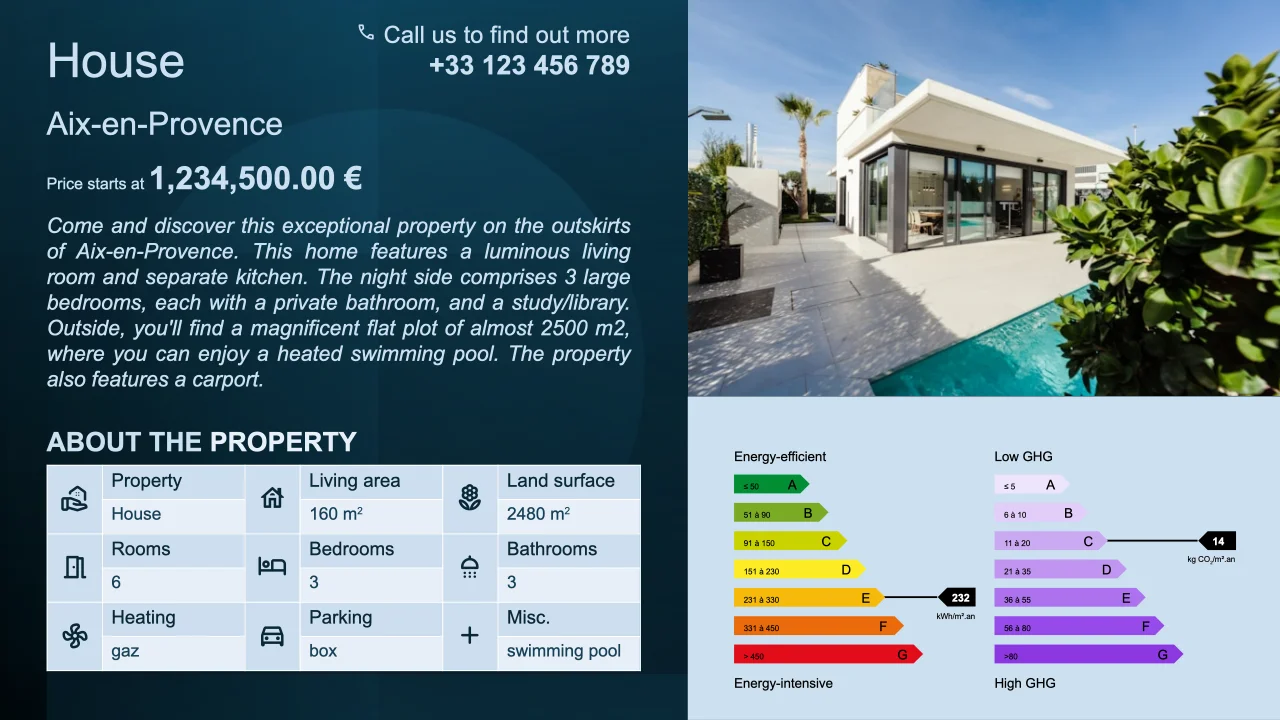
French property listing with fees, DPE scales and agent card
- Template
- PPTX
- Export as
- PDF, PPTX, ODP, PNG, SVG +29 more
- Carbone
- 5.18+
Generate listing sheets from your real estate CRM
Every property a French agency takes on mandate gets a listing sheet, the fiche vitrine: printed in A4 for the agency window, attached to emails, and handed out at viewings. Agency networks export it from their real estate CRM each time a listing is created or its price changes, so the photos, the price and the legal mentions always match the online ad. A French ad has mandatory mentions: the price with and without agency fees and who pays them (arrêté du 10 janvier 2017), the energy and climate classes on the A to G scales of the DPE with the estimated annual energy costs, and, for an apartment, the condominium facts (number of lots, annual charges, ongoing procedures). In this example, Orvalle Propriétés, a fictional luxury agency, lists a contemporary villa in Mougins on the Côte d'Azur: 284.5 m² on 2,400 m² of land, class B, sold 3,933,000 € fees included.
In this example, you will:
- Insert the photos of the listing and a QR code to the online ad
- Format prices in euros and areas the French way
- Repeat the features of the property in a bulleted list
- Move the DPE cursors to the energy and climate classes of the property
- Print the excessive consumption warning only for classes F and G
How to build a listing sheet with Carbone
1. Lay out the A4 slide
- Set the slide size to A4 portrait (21 × 29.7 cm): Design > Slide Size > Custom Slide Size. The sheet prints on any office printer and fits the agency window.
- Place the hero photo and a row of four photos at the top, then two columns: the title, the key facts, the description and the features on the left; the price, the energy scales and the energy costs on the right.
- Keep the legal mentions and the agent card in the footer, under a hairline.
2. Insert the photos and the QR code
- Insert a temporary image for each photo, with the size you want, and write the tag in its alt text (right-click > View Alt Text):
{d.photos[0].src}for the hero photo, then{d.photos[1].src}to{d.photos[4].src}. Carbone replaces each image with the photo of the data, here a Base64 data URI. A URL works too. - For the QR code, write
{d.listing.url:barcode(qrcode)}in the alt text of a square temporary image. Learn more about barcodes.
3. Format the price and the areas
- Add
{o.lang=fr-fr}to a text box that already holds content, here the listing reference: Carbone then formats numbers and euros the French way. - Print the price fees included first and larger, as the regulation requires:
{d.price.total:formatC(0)}prints 3 933 000 €, without decimals. Below it,Prix hors honoraires : {d.price.net:formatC(0)}andHonoraires : {d.price.feesRate:formatN(2)} % TTC. See :formatC and :formatN. - The living area keeps one decimal:
{d.facts.livingArea:formatN(1)} m²prints 284,5 m², and{d.facts.landArea:formatN(0)} m²prints 2 400 m² for the land.
4. Repeat the features
In a text box with a bulleted list, write the first feature in one paragraph and the second in the next:
{d.features[i].label}
{d.features[i+1].label}
Carbone repeats the paragraph for each feature. Learn more about repetitions.
5. Move the DPE cursors
- Draw the energy scale: seven Pentagon arrows, one for each class from A to G, each one 0.46 cm below the previous one and 0.2 cm longer, in the colors of the DPE label. Draw the climate scale the same way.
- Draw the cursor in front of class A: a dark pentagon pointing left and a text box on top of it with
{d.energy.primaryEnergy}. - In the alt text of both shapes, write two :transform tags. Chained :ifEQ and :show return the offset of the class, and Carbone keeps the first condition that is true: the first tag moves the cursor down, the second moves it right to follow the end of the longer arrow.
{d.energy.class:ifEQ(A):show(0):ifEQ(B):show(0.46):ifEQ(C):show(0.92):ifEQ(D):show(1.38):ifEQ(E):show(1.84):ifEQ(F):show(2.3):ifEQ(G):show(2.76):transform(y,cm)}
{d.energy.class:ifEQ(A):show(0):ifEQ(B):show(0.2):ifEQ(C):show(0.4):ifEQ(D):show(0.6):ifEQ(E):show(0.8):ifEQ(F):show(1):ifEQ(G):show(1.2):transform(x,cm)}- Build the climate cursor with
{d.energy.climateClass}and{d.energy.emissions}. The data sends the class of the DPE: the energy class of the double label is the worse of the energy and climate classes, so it cannot be computed from the primary energy alone.
The :transform() formatter moves shapes like rectangles and arrows, but not lines or groups. Draw a line as a very thin rectangle.
6. Add the energy costs and the legal mentions
- Print the costs with the mandatory wording:
Montant estimé des dépenses annuelles d'énergie pour un usage standard : entre {d.energy.costMin:formatC(0)} et {d.energy.costMax:formatC(0)} par an., followed by the reference year of the energy prices,{d.energy.priceReference}. - At the end of the same paragraph, add the warning of classes F and G. It prints nothing for the other classes, so it leaves no empty line:
{d.energy.class:ifEQ(F):or(d.energy.class):ifEQ(G):show(' Logement à consommation énergétique excessive.'):elseShow('')}- In the footer, print the ownership status, here
{d.ownership.status}for a house outside any condominium (an apartment lists its number of lots, annual charges and ongoing procedures instead), the Géorisques mention and the legal details of the agency, then the agent card with{d.agent.initials}in a circle.
Save the PPTX template, send the listing from your CRM as JSON, and Carbone returns the listing sheet in PDF, ready for print and email.
Related Examples
Trusted by 800+ paid customers in 40+ countries